
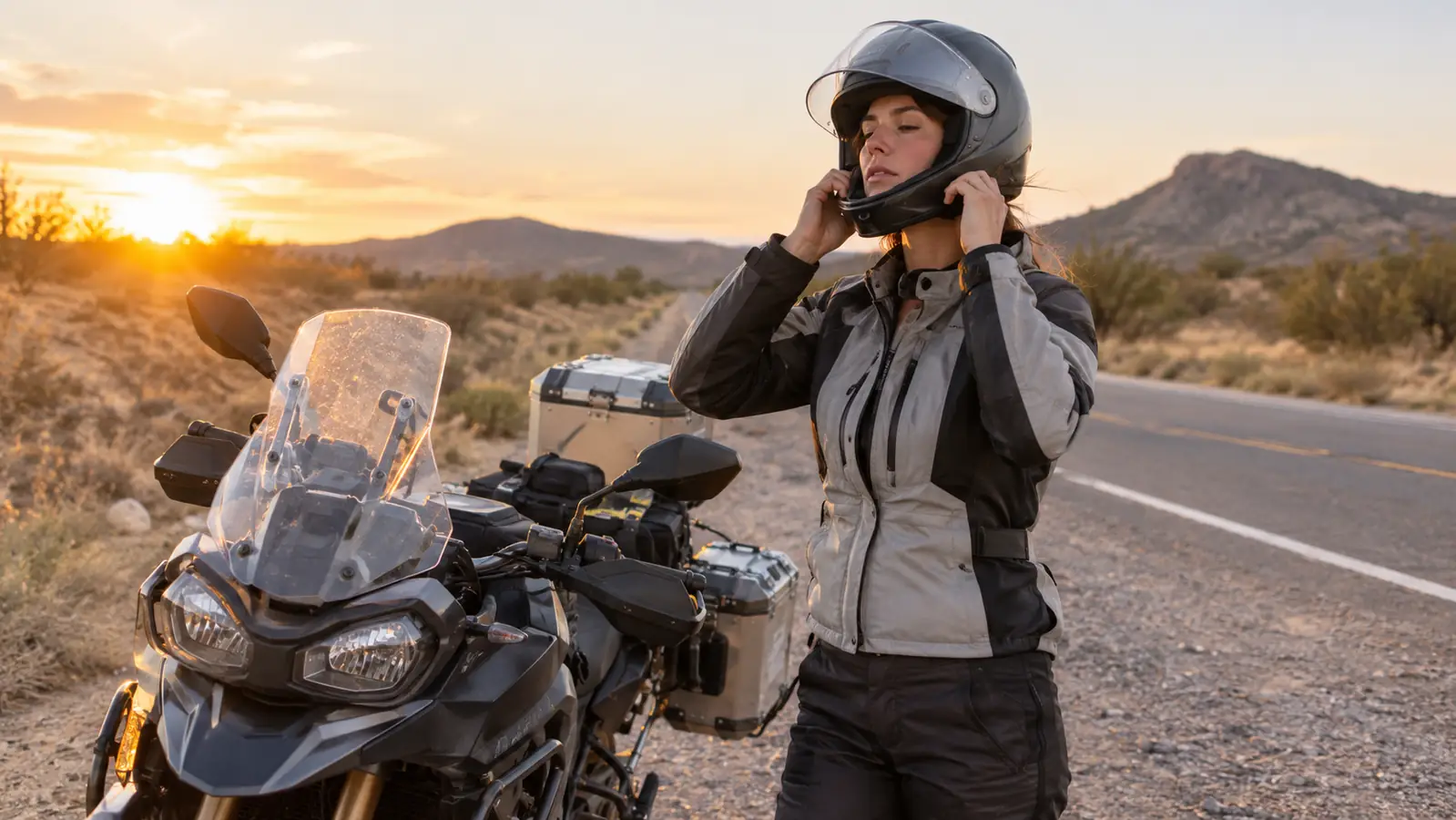
Wind noise does not care how good your hearing is. On the Gold Wing I can hear the engine, the tires, and a semi two lanes over, and somewhere underneath all of that is a calm voice telling me to turn left in 500 feet. For years I did what most riders do about it. I turned the volume up until I could hear the directions, which meant my ears took a beating for the whole ride and I still missed the exit.
What actually fixed it was not more volume. It was a Cardo headset sitting in my helmet, paired to my phone, with the volume set correctly while the bike was off and the helmet quiet around my ears. That is the whole method, and it is almost entirely about the order you do things in. Do it backwards and you will spend every ride with the volume pinned and a headache by the second tank.
Hear the Turn, Not the Wind
The Cardo SPIRIT pairs with any Bluetooth headset of any brand, weighs about 150 grams, and takes software updates over the air through the Cardo Connect app. Set it up once in the garage and it stops being a project.
Amazon Check Today's Price on Amazon →Step 1: Quiet the Helmet Before You Add Any Sound
Every decibel of wind noise your helmet makes is a decibel you will try to beat with the volume. So fix the noise floor first. A headset in a loud helmet is a losing argument, no matter what you paid for it.
On my bike the biggest offender was windshield height. It came set for a rider a couple of inches shorter than me, which put the turbulent air square at my helmet. Raising it an inch and adding a chin curtain cut the roar by what felt like half. I also stopped wearing a helmet that moved at speed. A helmet that shifts in the wind is a helmet that leaks noise straight past your ears.
I got there the hard way. In the spring of 2023 I bought a taller aftermarket screen, three inches over stock, because that is what the forums said to do. It moved the buffet from my face to the top of the helmet and made the roar worse above 55 miles an hour, and I took it off after two rides. The stock screen raised an inch beat it, and the whole fix took one afternoon. So did the chin curtain, which snaps along the bottom edge of the helmet and closes the gap between the liner and my neck. Before it, I could feel air moving up past my jaw at freeway speed, and that is the same air that carries the noise. After it, I noticed the difference before I reached the stop sign at the end of my street.
Then the earplug question, which comes up at every gas stop. Some riders refuse them because they want to hear traffic. I wear filtered plugs on highway days, and I hear traffic better with them in, because the wind is no longer covering everything else up. The headset only has to be loud enough to clear the plug, not loud enough to beat the wind. That is a much smaller job, and it is the one your ears can live with.
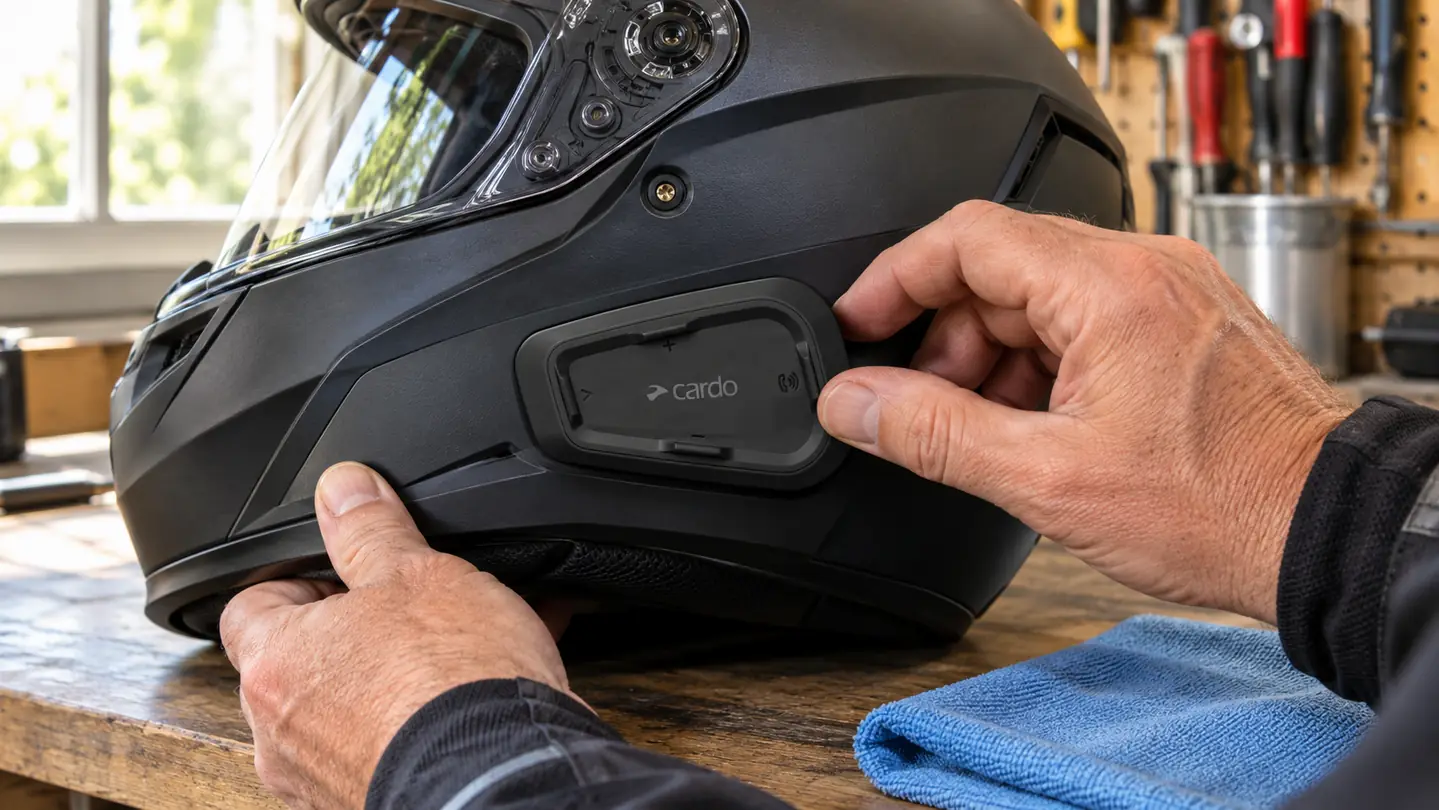
Step 2: Pair It Once, Properly, Then Forget It
Pairing is where people give up. Do it in the garage, not at a pump with your helmet half on and the engine idling.
Turn the unit on, open the Bluetooth menu on your phone, and look for it in the list. Cardo builds these to connect with any other Bluetooth headset of any brand, and the phone side is just as plain. If it does not appear, it is almost always because it is still paired to something else, usually the tablet in the house or the old phone in the tank bag.
I have made every pairing mistake there is. The worst was a Saturday in October, a two hour ride out toward the desert, when the directions stopped about nine minutes in. I pulled over, took the helmet off, and found the phone had grabbed the kitchen speaker when I walked past it on my way out the door and never let go. The headset had done nothing wrong. I had simply never told the phone where to send the sound, and it made a decision for me.
Once it is paired, test it before you put the helmet on. Start a podcast, set the phone on the workbench, and walk ten feet away. If the audio breaks up in the garage, it will break up at speed. Better to find that out standing still than halfway to Palm Springs. Then leave the pairing alone. Re-pairing every ride is how people end up with a headset they stop trusting.
My check now takes about nine seconds. Start the route, look at the audio output on the phone, and confirm it names the headset and not the phone speaker. That single glance has saved me three rides this year, and it costs nothing but the pause before you pull out of the driveway.
Step 3: Set the Volume at a Standstill and Leave It There
This is the step almost nobody does, and it is the one that solves the problem. Set your volume with the engine off.
I play a podcast at the level I think I want, then put the helmet on and stand next to the bike. If I can hear every word clearly with my hands at my sides, that is roughly right. If I have to strain for it, I go up two clicks and stop. That is the ceiling, not the starting point.
The first long ride I ever took with a headset, I set the volume at 70 miles an hour, because that was the only place I ever thought about it. That number was useless by the time I got off the freeway. At town speeds the directions were loud enough to make me jump, and out on the highway they vanished. A setting you dial in at one speed is wrong at every other speed, and you spend the whole ride chasing it with your thumb instead of watching the road.
Then start the bike and let it idle. That idle test matters more than any spec sheet. The 32 millimeter drivers in the SPIRIT are small, and small drivers do not get louder so much as they get harsher. Once you hear the edge of harsh, back off two clicks. Harsh volume is what turns a three hour Sunday ride into a nine hour one, and it is the reason people decide motorcycle audio does not work.

Step 4: Line the Speakers Up With Your Ears
The unit weighs about 150 grams, so mounting it is not the hard part. The hard part is where the sound lands.
My first mount was off by about half an inch and I did not know it for three weeks. I put the speakers where the liner pockets were stitched, because that seemed like the obvious answer, and then turned the volume up to make up for how thin everything sounded. When I finally pulled the liner out and looked properly, the pocket on the left sat forward of my ear canal and the pocket on the right did not. Helmets are not symmetrical after a couple of seasons of being worn.
Helmet liners have pockets over the ears, but those pockets are not in the same place on every helmet, and my ears are not in the same place as yours. If a speaker sits forward of the ear canal, you lose most of the body in the voice and you turn the volume up to make up for it. Pull the liner, set the speaker directly over the ear, and check it with the helmet on your head before you button everything back together.
The correction is a two minute job once you know to do it. Set the speaker, put the helmet on, press it toward your ear, take it off, move it back. Mine ended up about a quarter inch behind the stitching on the left side. Same volume setting, same road, and the voice stopped sounding like it was coming from the next lane over.
Same idea with the microphone. Get it close enough that it picks you up at a normal speaking voice. If you have to raise your voice to be heard, the person on the other end gets a rider shouting over wind, and you are the one who sounds bad. One pass with the helmet on, saying the street names out loud, tells you more than a page of instructions.
Step 5: Do the Updates at Home, Then Put the Phone Away
The SPIRIT takes over the air software updates through the Cardo Connect app. Do them in the driveway, on a charged unit, with the bike off and the helmet on the bench. Not the night before a trip, and never in a parking lot with one glove off.
The app is worth ten minutes once. Check the firmware, confirm the settings, and then stop opening it. Anything I need to change at speed waits until the next stop, because a rider holding a phone is a rider with one hand off the bars. My hands go numb on long days as it is. I do not need to add a reason to let go.
Charging follows the same rule as the updates. It happens the night before, in the house, alongside checking the tire pressure and topping off the tank bag. I keep the cable in a small zip bag in the top case so it does not end up loose in the bottom of a pannier, and I look at the unit at the same time I look at my phone. Gear that gets charged at the last minute is gear that dies at the worst moment, and a dead headset is worse than no headset, because you spend the whole ride waiting for it to come back.
What Else Helps
Earplugs, but the right ones. A foam plug that kills everything makes the headset pointless. A filtered plug that takes the edge off the wind keeps a voice clear at a lower volume, which is the entire goal.
Vents are noise too. I run warm, so in the desert heat I ride with the chin vent open most of the year, and I would rather be cool than quiet. The trade is real. An open vent raises the noise floor by a noticeable amount, which means the headset has more work to do. When I need the directions clean, I shut the chin vent for the stretch where the turns matter and open it again on the straight.
Know what you are buying on the passenger side. This is a one pack. Ray rides pillion maybe six times a year and he does not have a headset, so we still use a tap on the shoulder and hand signals at stoplights. If you ride two up often, plan for two units from the start instead of finding out halfway up the coast that only one of you can hear the turns.
And check the helmet itself before you blame the electronics. A loose visor, a missing chin curtain, and a windshield set too low will beat any speaker ever made. I spent a month convinced my first headset was weak when the real problem was a visor that whistled above 50 miles an hour. Fix the whistle and the directions suddenly sound perfectly fine at half the volume.
The fix was never louder. It was quieter around my ears, set at a standstill, and then left alone for the rest of the ride.
Set It Up Once, Then Just Ride
Bluetooth that talks to any brand, 150 grams on the side of the helmet, and updates handled in your driveway instead of on the shoulder. That is the whole job.
Amazon Check Today's Price on Amazon →