

The short answer: if you ride alone most Sundays and want a headset that pairs with whatever your friends already own, the Cardo Spirit is the easier thing to live with. If your whole group already runs one brand and you want the deepest intercom features that brand sells, a Sena is the sensible pick. That is the split in one breath. The rest of this is why.
I am 54, I ride a 2019 Gold Wing, and I have been doing Sunday loops through the foothills near my house in Riverside County for 19 years. My hearing is fine. My patience for fiddly gear is not what it was at 35. I have run the Cardo Spirit on those rides for a while now, and I have borrowed a friend's Sena headset often enough to know where it fits and where it irritates me. Neither one is a bad purchase. They are built around different assumptions about how you ride, and those assumptions show up in small places, mostly at gas stops and in the first ten minutes of a ride when everyone is trying to get connected at once.
The Two Headsets, Side by Side
Here is the part I wish more reviews would show. These two units are close on the things that matter for a solo rider and quite far apart on the things that matter when you talk to a group all day. Read the table with that in mind. The Sena column is not padded, and it wins several rows outright. I am not going to pretend otherwise to make the page tidier than the truth.
| Cardo Spirit | Sena Bluetooth Headset | |
|---|---|---|
| Pairing with other brands | Connects with any other Bluetooth headset of any brand, and pairing is genuinely quick | Pairs across brands too, but the smoothest features are reserved for other units of the same brand |
| Controls | Set up and adjusted through the Cardo Connect app on your phone | On-unit controls, which some riders prefer so they never touch a phone mid-ride |
| Weight in the helmet | 150 g for the unit | Comparable in hand; neither one is the thing that makes your helmet feel heavy |
| Software updates | Over-the-air updates through the app, so the unit keeps current without a cable | Updates exist but the process is more involved |
| Audio hardware | 32 mm dynamic drivers with active noise cancellation for wind and road noise | Solid audio; tuning and loudness vary by model, so listen before you commit |
| Group riding and intercom depth | Fine for rider-to-passenger and small pairings; not the point of the unit | Deeper intercom features on the upper models, which is the reason people pick the brand |
| Warranty | 2 year manufacturer warranty | Varies by model, so check before you buy |
| Phone dependency | More phone-dependent for setup and changes | Less phone-dependent day to day |
| Best for | Solo riders and small groups who want easy cross-brand pairing | Riders already inside a group running the same brand, or chasing maximum intercom reach |
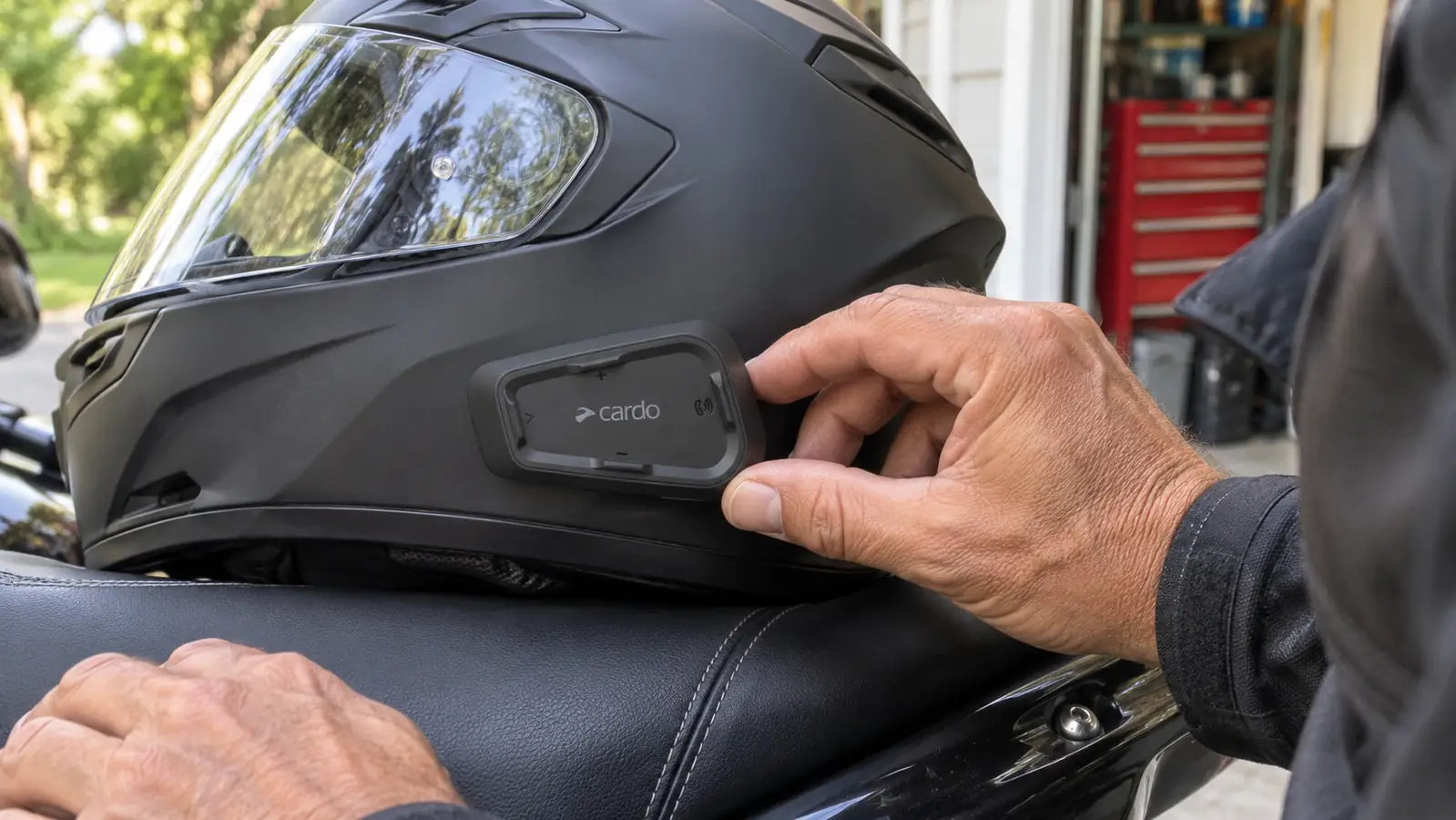
Where the Cardo Spirit Wins
The thing I keep coming back to is the word any. The Spirit connects with any other Bluetooth headset of any brand, and in practice that means I am not the person holding up the group at the gas station while everyone works out whose unit talks to whose. The first time I tested it, I stood next to a friend's bike at a station off Highway 74 and we were connected before the pump clicked off. I had not read anything. He had not read anything. That is the whole value proposition, and it holds up on a Tuesday as well as it does on a Sunday. If you ride with a rotating cast of people, that is worth more than any spec sheet line, and it is the reason I stopped carrying a strong opinion about brands.
The second win is maintenance by not thinking about it. Setup and adjustments live in the Cardo Connect app, which means I did the whole thing once on a Saturday evening in my garage with the phone propped on the seat, and I have not thought about it since. Over-the-air updates arrive through that same app, so the unit stays current without me hunting for a cable or a laptop. I am the kind of person who will simply never do a firmware update that requires a cable and a manual. The update I ran took a few minutes with the phone in my jacket pocket. That is the level of effort I am willing to give a headset.
The third is the audio and the plain number at the end of the listing. The 32 mm dynamic drivers with active noise cancellation do real work against wind noise. On the 74 at 65 mph, with a crosswind coming off the dry side of the hills, I can hear a podcast at a volume that does not leave my ears ringing when I stop. I run warm, so I ride with the visor cracked more than most people would, and that extra wind noise is exactly what the noise control is fighting. Then there is the 2 year manufacturer warranty, which is a checkable number instead of a promise. I like checkable numbers. I have filed a warranty claim on riding gear exactly once in 19 years and I still want the number to be there.
The one that pairs with whatever your riding friends already own
No brand loyalty required. The Cardo Spirit connects with any other Bluetooth headset of any brand, updates over the air through the app, and carries a 2 year manufacturer warranty. Check today's price before your next group ride.
Amazon Check Today's Price on Amazon →Where the Sena Wins
I will not pretend the Sena is the lesser unit, because on two dimensions it plainly is not. The controls are the big one. The Sena units I have used put the controls on the unit itself, and there is a real argument that this is better. At a stoplight on Florida Avenue in Hemet I watched a friend reach up with a gloved hand, tap twice, and turn his music down. I had to take my phone out of my jacket, wake it, and find the app. He was done before the light changed. I was still squinting at a screen. A rider who does not want a phone in the loop mid-ride will prefer his setup, and I understand exactly why.
The other is group intercom depth. If you ride with four or five people who all run the same brand, that ecosystem is built for the way you actually ride in a way the Spirit simply is not. The Spirit handles rider-to-passenger and small pairings without complaint, but it is not trying to be a rolling conference call, and I do not think it should pretend to be. If your Saturday group is the same six people every week and they all bought the same brand years ago, buying into that brand is the pragmatic choice, not a compromise. Being the odd unit out is a lonely way to ride, and no amount of cross-brand convenience fixes that on a long day.
There is a third, quieter point in the Sena's favor, and it is a human one. When everyone in the group runs the same gear, troubleshooting stops being a group activity. Nobody spends twenty minutes at the start of a ride diagnosing somebody else's pairing while the rest of the group sits on their bikes with their visors down. That is worth something, even if it never shows up on a comparison chart. I have been the odd unit in a group, and the rides still work, but the first ten minutes are always a small negotiation.
I have paired the Cardo Spirit with a friend's off-brand unit in under a minute, standing in a parking lot, without reading anything.

The Honest Middle Ground
Weight is where the marketing gets silly on both sides. The Spirit is 150 g for the unit, and in the helmet neither this nor a comparable Sena is the thing that makes your head tired after four hours. Neck fatigue comes from helmet fit, wind buffeting, and posture, in that order. I have done a 300 mile day and blamed the helmet, the windscreen, and my own shoulders, and never once the headset. Do not let a purchase decision hinge on a weight figure you will never notice.
The other thing nobody tells you is that both units are only as good as your helmet's speaker pockets. If your helmet has shallow cutouts, either brand will press on your ears by hour three and you will blame the headset. Pull the cheek pads, look at the pocket depth, and sort that out first. I did this after a ride where my right ear was sore for two days, and the fix took fifteen minutes and some patience. My hands go numb on long days and I am particular about pressure points, so I learned this the annoying way rather than the smart way.
Something else worth saying plainly: no headset fixes wind. A quiet helmet and a decent windscreen do more for what you can hear at highway speed than any setting on either unit. I noticed this when I started paying attention to the top of the screen and the angle of the air hitting my helmet instead of the electronics inside it. If you can hear nothing at 70 mph, the answer is usually the air, not the drivers. Sort the air first and the electronics get simple.
And there is a passenger question. Ray rides pillion a couple of times a month, and rider-to-passenger pairing is the feature I actually use most. The Spirit does that without drama, which is exactly what I want on a Saturday morning when we are trying to leave before the heat builds. If you ride solo almost always, that whole category of feature is worth less than you think and should not move the decision.
One more tradeoff worth naming: because the Spirit leans on the app for setup and changes, your phone becomes part of the routine. Mine lives in my jacket pocket and the battery is fine, so this has never cost me anything. But if you are the sort of rider whose phone is usually nearly flat by noon, or who leaves it in the saddlebag and forgets about it, the on-unit controls on a Sena ask less of you. That is a real difference and it is not a small one for everyone.
Who Should Buy Which
Buy the Cardo Spirit if you ride solo or with a small, mixed group, if you want cross-brand pairing to just work, if you would rather set things up once in an app than learn a button sequence, and if you want updates to arrive without a cable. It is also the sensible pick if you are adding communication to a helmet for the first time and do not want to commit to an ecosystem before you know whether you even like riding with a headset. That is most everyday riders, honestly. The 2 year manufacturer warranty and the active noise cancellation do not hurt either.
Buy a Sena if you are already inside a group that runs the brand, if intercom depth is the actual reason you are shopping, or if you know yourself well enough to know that on-unit controls are non-negotiable and a phone-based setup will drive you up a wall. Those are legitimate reasons, and no amount of pairing convenience outweighs riding with the people you actually ride with. I would make the same call in your position, and I would not feel like I settled for second best.
What I would not do is buy either one for the audio alone. Both play music and both handle a phone call at a stop, and the difference between them on that front is smaller than the difference a decent helmet and a quiet windscreen make. Buy for how you ride and who you ride with. That is the decision. The rest is detail, and detail is a lot easier to live with when the first ten minutes of a Sunday are not spent negotiating with a pair of electronics.
Easy pairing, over-the-air updates, and a warranty you can actually check
For everyday riders who want communication that works without a brand loyalty oath: the Cardo Spirit connects with any other Bluetooth headset of any brand and carries a 2 year manufacturer warranty. See the current price and the full listing on Amazon.
Amazon See the Cardo Spirit on Amazon →