
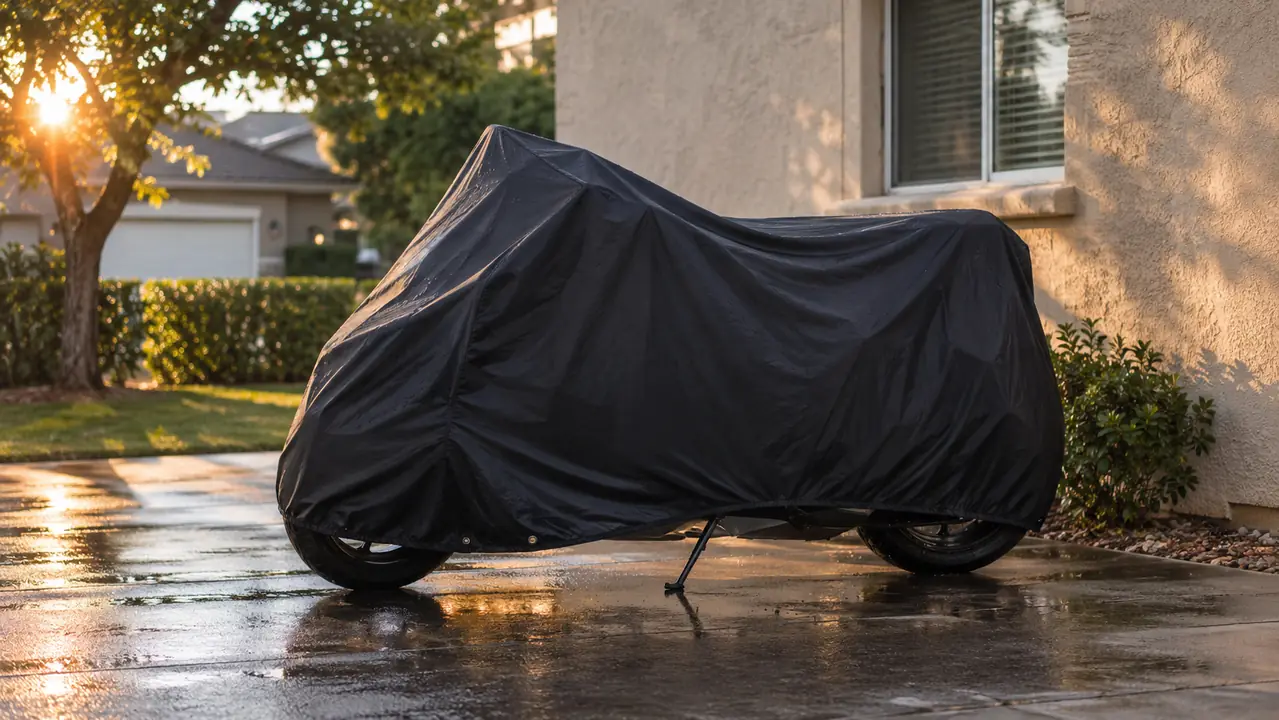
Not every rider has a garage, and the ones who do often find it full of everything but the motorcycle. Mine was, for years. The Gold Wing sat in the driveway under a cover from October to April while the garage held a table saw, two bicycles, and a stack of Ray's lumber. It took me a few seasons to learn that outdoor storage is not a matter of throwing a sheet over the bike and hoping. It is a short list of habits, and if you get them right, the bike comes out in spring in better shape than plenty of garage-kept bikes I have seen.
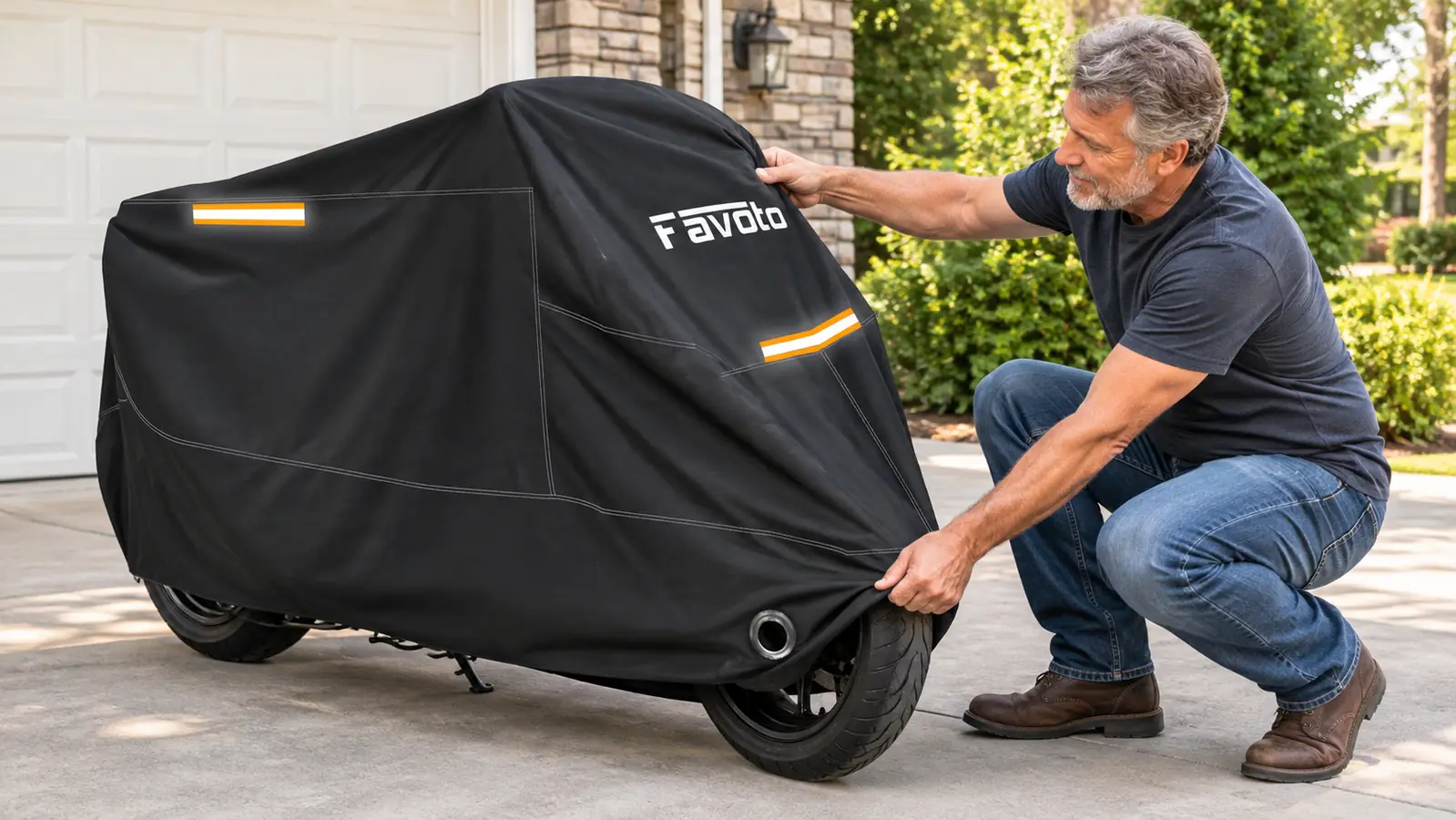
I have used a Favoto cover on that bike long enough to have opinions about what a cover can and cannot do. It is 300D Oxford fabric, waterproof, and it measures 96.5 inches long by 41 wide by 50 high, which fits a full dresser with the windshield still on. It is not an expensive piece of gear. But the cover is only half the job. The other half is where you park it, what you do to the fuel and the battery, and how you stop the whole thing from turning into a sail when the wind comes through the pass.
The cover that has spent four winters on my bike instead of in a landfill
300D Oxford fabric, waterproof and tear-resistant, with an elastic hem, UV protection, and two aluminum-alloy lock holes at the bottom. Folds into the included storage bag, so it rides in the saddlebag when you travel.
Amazon Check Today's Price on Amazon →Step 1: Pick a Spot That Drains and Does Not Bake
The single biggest mistake I see is parking on the low spot in the driveway, the one where water stands after a rain. A cover keeps rain off the top of the bike. It does nothing about two inches of water sitting under the tires, and it does nothing about the moisture that comes up out of wet concrete for hours after the storm has passed. Find the high corner. If your driveway slopes toward the street, park at the top of it, and if you have a side yard that stays dry, use it.
Sun is the other half of this. Riverside County gets a lot of it, and the same UV that bleaches a plastic lawn chair will go after a seat, a windscreen, and a tire sidewall. A cover blocks most of that, so park where the bike catches morning sun rather than eight hours of afternoon sun, and keep it out from under the eave where the gutter drips. Tree sap and bird droppings are their own problem, and neither comes out of fabric easily.
Wind matters more than people expect. A covered bike is a sail. A spot against a wall, a fence, or the side of the house gives the cover something to hide behind. A bike standing alone in an open side yard takes the full Santa Ana gust and will rock, tip, or work the cover loose overnight. If your choice is between a sunny spot out in the open and a shaded spot against the house, take the house.
Step 2: Wash and Dry the Bike Before Anything Goes Over It
Dirt under a cover is worse than dirt in the open, because the cover holds the moisture against the paint. Road film, dust, and bug splatter all pull water out of the air. Wash the bike, rinse it well, and then let it dry completely before anything goes over it. Completely means the seams around the tank, the underside of the fenders, and the space behind the saddlebags. A microfiber towel gets into those spots. A garden hose does not.
The other reason to wash first is that you will find things. A weeping fork seal, a rock chip in the paint, a soft tire, a bolt that has started to back out. Discovering that in October is much cheaper than discovering it in April when you actually want to ride. While the bike is clean and dry, put a coat of wax on the painted surfaces. Ten minutes now makes spring cleanup a rinse instead of a scrub.
Do not cover a warm bike. The engine, the exhaust headers, and the converter under the bike all hold heat for a long time, and fabric resting against a hot pipe is not a good combination. Give it an hour. Longer if you just came off a long Sunday ride. I do the wash, then lunch, then the cover.
The elastic hem and the two lock holes do more for a cover's survival than the fabric does. If wind can get under it, wind will find a way out.
Step 3: Deal With the Fuel and the Battery Before You Forget
For anything longer than a few weeks, fill the tank nearly to the top before you park it. A full tank leaves very little air space, and less air space means less room for condensation to form on the inside of the tank walls. If the bike is going to sit for three months or more, add a fuel stabilizer, run the engine long enough for the treated fuel to reach the injectors, and then shut it down and leave it alone.
The battery is what actually strands people in spring. A motorcycle battery that sits for months will self-discharge, and a discharged battery sulfates, and a sulfated battery does not come back. Either pull it and keep it on a tender indoors, or leave it in the bike and run a tender lead out at the rear wheel, where the elastic hem will close around it instead of leaving a gap. Check the tender once a month so you know it is still doing its job.
Tires deserve a mention. Pump them to the pressure on the sidewall or in the manual before storage, because a soft tire sitting in one place for months will flat-spot. If you can, get the tires off bare concrete, which wicks moisture, and onto a piece of plywood or a rubber mat. If the bike has a center stand, use it. It takes the weight off the front tire and makes the whole package more stable in wind.
Step 4: Fit the Cover Front to Back, and Mind the Hot Parts
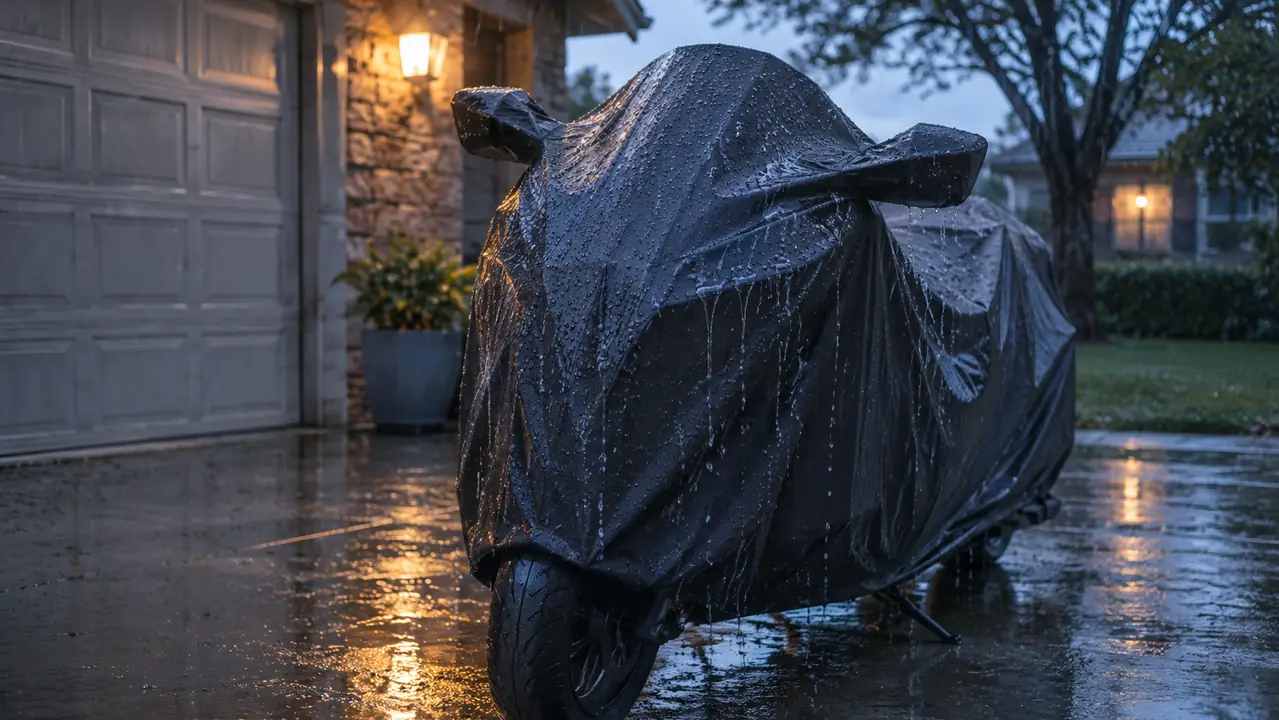
Start at the front. Drop the cover over the windshield and the handlebars first, then walk it back over the seat and the tail. Going front to back means the fabric slides down over the tall parts instead of being dragged up from behind, which is how you scratch a tank you just waxed. The Favoto cover is sized at 96.5 inches long, 41 inches wide, and 50 inches high, and on a full touring bike that is a close fit. Close is good. Loose is not.
Make sure the cover is fully seated over the mirrors and the windscreen before you let go of it. A mirror poking at the fabric from underneath will stretch that one spot and eventually wear a hole through it. Same with an antenna, if your bike has one. Once it is down, walk the perimeter and pull the hem so the elastic sits below the axles rather than halfway up the wheels.
Then check the inside of the cover itself. If it has been folded in a saddlebag or sitting on a garage floor since last season, shake it out first. Grit on the inside of a cover does the same damage as grit on a wash mitt, and it is a lot harder to see. And wait for the exhaust to be cool. I said that already. I am saying it again because it is the mistake that ruins covers.
Step 5: Lock It Down and Check It Every Couple of Weeks
The cover has two aluminum-alloy lock holes at the bottom, one at the front and one at the rear. A lock is not included, which is fine, because you probably already own a cable lock. Run the cable through the front wheel and through the front hole, and if you have a second lock, do the same at the back. That does two things at once. It makes the bike much harder to walk off with, and it keeps the cover from lifting in a gust.
Then check it. Not every day. Every couple of weeks is enough, and always after a real storm. What you are looking for is water pooled in the low spot of the seat, the cover pulled half off one mirror, or damp trapped between the cover and the tank. Small problems turn into big ones over four months. Two minutes with a flashlight in December saves a full detail job in April.
One thing I do not do is tie the cover down tight around the middle with rope. The elastic hem is there to hold it, and rope compresses the fabric flat against the bike in a way it was not cut for. If you need extra insurance in wind, park closer to the house, not tighter on the cover.
What Else Helps
A cover is not the whole list. Before the bike goes under for the season, take a photo of the odometer and the tire pressures and write the date on it. In April you will want to know whether anything changed while it sat. The Favoto cover also comes with a waterproof storage bag, and that bag is worth keeping in the saddlebag during riding season. A wet cover folded into a top case will sour everything else in there by the end of the day.
Do not substitute a plastic tarp. A tarp is not cut for the shape of a motorcycle, it has no hem to hold it, and it traps whatever moisture is underneath against the paint and the chrome. This cover is cut for the shape of a bike and has an elastic bottom that keeps it where you put it. Use it the way it was built and skip the blue tarp entirely.
Last thing. If you can get the bike up on the center stand and put a scrap of plywood under the side stand, do it. Concrete wicks moisture upward, and a kickstand sitting on the same square inch for four months is how you end up with a rust ring you cannot explain to anybody. It is a small chore, it costs nothing, and you will be glad you did it.
Four winters outside, one cover, and the bike still cleans up in a rinse
96.5 by 41 by 50 inches, 300D Oxford fabric, waterproof with UV protection, elastic hem, two aluminum-alloy lock holes, and a storage bag included. At 1.5 pounds it packs down small enough for the saddlebag on a coast trip.
Amazon Check Today's Price on Amazon →